
Wednesday, 3 June 2026
Wednesday 3 June 2026
[1] University of California stopped requiring an ACT or SAT score in 2020. At the time, critics said that such standardized testing limits the opportunity for “Black, Hispanic and poor students”. More than 1,100 University of California math and science professors recently delivered a letter to the university saying that there has since been a sharp decline in readiness among students studying science, technology, engineering and math.
Nearly one third of student taking first semester calculus at UC Berkley “displayed severe preparation deficits” the letter said. “We now observe preparation gaps so severe that instructors must reteach middle-school mathematics while simultaneously teaching the material students need for sciences, engineering, economics, and other quantitatively demanding fields,” the faculty wrote.
DNF takes the following stance: while there must be a concerted effort to support people from less-privileged backgrounds, the timing of the support is key. Time, money and effort should be spent on assistance at younger ages, when students are developing their abilities, not during the acceptance process at colleges.
Furthermore, academia should be a place for brilliant minds to interact freely without worrying about race, sex, religion or other individual-specific factors, it must be in order to keep pushing the boundaries of human knowledge.
[2] Short selling is the phenomena of betting that the price of something (a stock, a commodity, a bond) will go down. Short sellers are often abhorred by CEOs, who are always long (the opposite of short, betting that the price will increase) their company’s shares, but they play an important role in price discovery in the markets (if you could only bet that the price will increase, what would you do if you thought the price was too high?).
Andrew Left is one of the most prolific short seller of recent times. The 55 year old made a fortune by researching companies, accusing them of fraud and betting that the price would fall (shorting the stock).
What Left did, however, was not right.
Prosecutors managed to convince the court that Left distorted markets with noisy, misleading campaigns against stocks. In an unprecedented move, Left took to the bench to testify in his own defense. He was less convincing on the bench than he was on social media. Left was convicted on most of the 17 counts he faced. His lead securities-fraud charge carries a maximum 25-year prison term, he plans to appeal the verdict.
[3] Google parent company Alphabet is raising $80 billion through a package of equity offerings, a rare move for a large public company. The funds will be used to fund – you guessed it – AI infrastructure. Google’s homegrown AI chips, known as tensor processing units or TPUs, have become a key alternative to Nvidia’s market-leading chips.
Google’s CFO Anat Ashkenazi indicated that the second biggest company in the world’s 2027 capital expenditures will be significantly higher than the 2026 budget of $190 billion, with analysts forecasting that it could reach up to $300 billion.
[4] Walmart joins Uber and Microsoft in cutting employee AI usage, citing cost concerns. Walmart’s in-house AI platform, called Code Puppy (should we be concerned about the cute names these AI models have? Feels a bit like the choo-choo train move you pull on a toddler when feeding them medicine), is implementing a token based system after high demand.
AI builders continues to spend lavishly on infrastructure, while AI users continue to cut usage. This really feels like a disconnect which is seemingly not priced into the market.
[5] DNF is quickly becoming an AI newsletter, we promise to diversify in the future (or not, it’s our Substack). But it certainly feels like the US market is become a single-narrative environment.
While you might feel far removed from all this AI talk, you are not. Take a look at the SP500 index weightings.
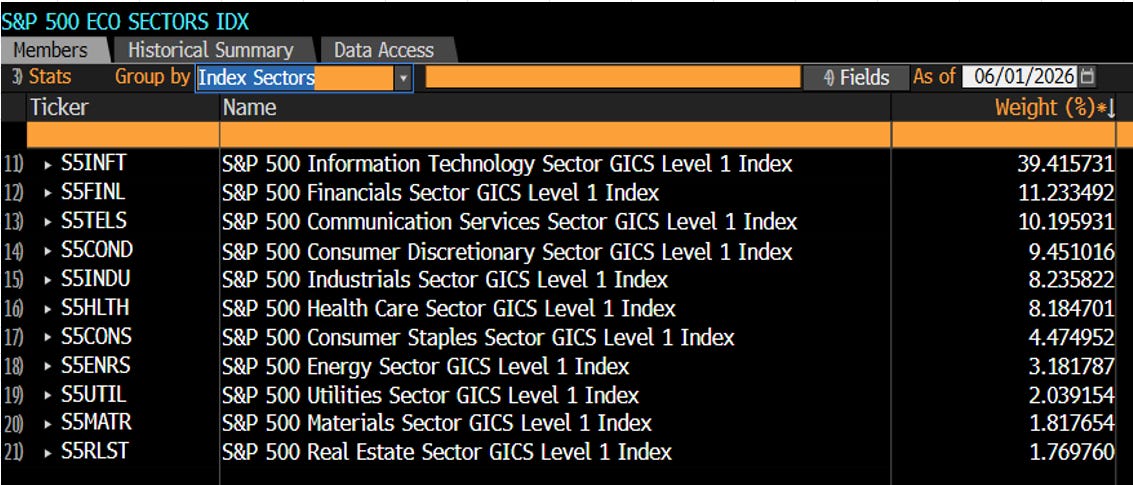
Source: Bloomberg
Remember, the SP500 is supposed to be a safe, long-term investment, because of a financial concept called diversification. In its simplest form, diversification is buying two shares that move in opposite directions on the same catalyst.
For example, if you buy a fossil fuel company and a renewable energy company and the government writes a law that bans the use of oil (this will never happen, frack baby frack as Trump said), your fossil fuel stock falls and your renewable energy company stock climbs.
Conversely, if the government bans wind turbines (also won’t happen, but more likely under Trump who is on record as saying that windmills are “driving the whales crazy”(??)), renewables fall and fossil fuels rise, because you still need energy to charge your iPhone.
Historically, the SP500 has been a safe bet because by buying it, you invests in 500 big companies in the United States, so you get the benefit of diversification. This is not the case today, as almost 40% of the SP500 is weighted towards (dependent on) the Information Technology sector (read AI shares).
So, if something were to happen that impacts the AI industry, such as energy prices skyrocketing to unsustainable levels ($95 Brent anyone?) or a more left leaning future US administration clamps down on data centers, you are actually not diversified at all and the SP500 will come crumbling down. This is bound to happen, and has happened many times historically (see dot-com bubble) but making money from it (or not losing money as a result) is more nuanced, because you must know when it is going to happen.
There are many other relevant facts to discuss surrounding this, such as the amount of capital in ETFs, index-inclusion rules changing and retail investors’ weight in the market, but for now this will suffice.
[6] The South African government continues to prevent Elon Musk’s Starlink internet provider, that fires satellites into space so that you can scroll TikTok in the wilderness, to launch in the country.
Musk refuses to partner with local suppliers, instead preferring to own the entire value chain (who doesn’t). The more contentious point is Musk’s refusal to relinquish 30% ownership to historically disadvantaged groups. Musk has offered to provide free internet to 5,000 rural South African schools if the government waives the requirement. This seems like a no-brainer (the deal, not the SA government…) but remains unresolved.
[7] The Euro-area inflation crossed 3% for the first time in two and a half years as the impact of higher energy prices continue to ripple through markets. A rate hike by the European Central Bank (the ECB, SARB in SA, Fed in US, refer to DNF’s note on 29 May for an explanation) seems very likely. As sovereign debt (“sovereign” refers to countries, in other words the amount of debt a government has) around the world continues to climb, rate hikes will put further pressure on governments with already tight budgets. This will impact consumer’s ability to put food on the table and politicians’ ability to have summer holidays in the south of France.
[8] Chess is believed to be 1,500 years old, first played in India in the 6th century CE. There are more possible positions on a chess board than there are atoms in the observable universe (actually). For the past decade, the game has been dominated by Norwegian grand master Magnus Carlsen. His statistics are beyond belief. To be on the top of a game with so many intricacies and theory for so long is no small feat. But there is an interesting phenomenon that seems counterintuitive – players over roughly the age of 30 can simply no longer stay at the top of the game. There are, of course, brilliant 30+ year old grand masters (Magnus included), but in chess you play against two opponents, the one across the board and the clock. As players age, despite having many more years of experience and having played many more positions, the brain can simply not calculate quick enough to remain at the top of the game. Magnus, for the first time in his career, is realizing this. The 35 year old is having a difficult tournament in his home country, where the Norway Chess Championship is underway. He currently ranks 5th out of 6 players, having won only 2 games. Wesley So (32 years old) leads, with Alireza Firouzja (22 years old) and Indian superstar Rameshbabu Praggnanandhaa (20 years old, known as Prag, wonder why), in second and third respectively. Carlsen will be frustrated, but regardless of this or future tournaments’ outcome, his legacy will endure in the sport (hmm…) forever, among and above the likes of Bobby Fisher and Gary Kasparov.
[9] Has anyone else noticed that corporations have not changed their LinkedIn profile pictures to rainbow logos during June this year? DNF wonders why these corporations have stopped celebrating the sexual preferences of their employees, almost as though it had nothing to do with them in the first place. One might even say that it was an absurd and shallow attempt at not being cancelled (don’t ask Kid Rock or his machine gun about this, also avoid asking Anheuser-Busch about their logo).
[10] The Hawks (South Africa’s FBI equivalent) management team, still busy investigating the Woolies bombing spree, has allegedly been linked to criminals who pulled off a theft of 541kg of cocaine worth R200 million from police offices in KZN (the theft took place in 2021, the SA justice system at work). We previously stated that the Woolies debacle will take years to solve, but we now believe that the Hawks will have renewed focus and the ability to work four days in a row without sleep, so we adjust our forecast to a few months.
Have a great Wednesday!