
Tuesday, 9 June 2026
Tuesday 9 June 2026
[1] Apple’s WWDC26 kicked off yesterday and will run until 12 June. Tim Cook delivered the keynote, his final before stepping down as CEO on 1 September.
The centerpiece of WWDC26 is Siri 2.0 with Apple enthusiasts expecting a fully rebuilt chatbot powered by Google’s Gemini model (if you can’t beat them, join them). Early reports from yesterday’s event also hint at a foldable iPhone being announced.
During his 15 years as CEO of Apple, Tim Cook was cooking.
The company’s market capitalization grew from $300 billion to $4.5 trillion under Cook’s management and Apple grew and cemented its position as the best-in-class smartphone, laptop and tablet maker.
While there were certainly missteps during his tenure (Apple Vision Pro, Project Titan, which was a secret, decade-long Apple Car R&D effort which resulted in nothing more than burning a few billion dollars of cash and most recently, Apple Intelligence) the brand strength matched with genuinely stunning performance across its core product range will be Cook’s legacy.
Apple share price 1 January 2011 - Current
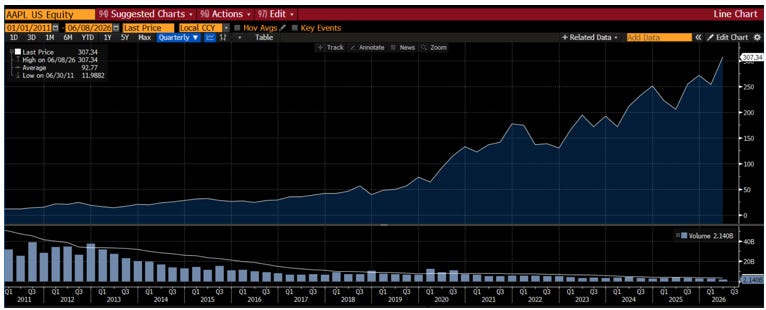
Source: Bloomberg
[2] DNF reported yesterday that the KOSPI dropped 6.5% during the Asian session. This sudden drop (at a certain point the index was down almost 10%) triggered an interesting stock exchange mechanism: a circuit breaker.
While stock traders are often viewed as rational, stoic intellectuals who operate within the ordered world of numbers, they are also humans with outstanding payments on IWCs and Porsches, who, collectively, hold the ability to crash the global economy.
As such, markets have built in controls to prevent a panicked race to the bottom. When volatility spikes and markets drop excessively in a small amount of time, trading is literally suspended for a few minutes (sometimes 15 minutes, sometimes longer) to allow investors a moment to finish their Red Bull, smoke a cigarette, and re-read the flashy news headlines that used scary words like “meltdown”, “crash” and “the bubble has burst”.
The previous circuit breaker in the US was in March 2020 when the pandemic sent Wall Street into panic. The fact that the Korean exchange hit this point is evidence of just how fragile the market can be sometimes in such a volatile environment. The KOSPI is up 8% today, as markets continue to whipsaw. Pity the Korean day trader who is out of position.
DNF also noted that many well-respected financial publications continue to use the verb “betting” when describing what tech companies are investing in (“Google is betting big on AI infrastructure”), which says a lot.
[3] Despite Gen Z (individuals born between 1997 and 2012) living through the introduction of the internet, the dot-com crash, the global financial crisis (GFC), countless wars in the Middle East, the introduction of social media, the introduction of AI, Covid-19, two Trump presidencies and Drake’s recent album release, they are drinking considerably less alcohol.
54% of Americans reported drinking in 2025, down from 67% in 2022 - the lowest rate in nearly 90 years of Gallup surveying. The rise in awareness of mental and physical health is driving Gen Zers to healthier habits.
Meanwhile, Strava subscriptions are through the roof, with Gen Z leading the charge. This does not bode well for the alcohol industry and associated stocks, with brands increasingly rolling out zero-alcohol alternatives.
Increase in share of runners recording races on Strava (in 2025) vs. 2024
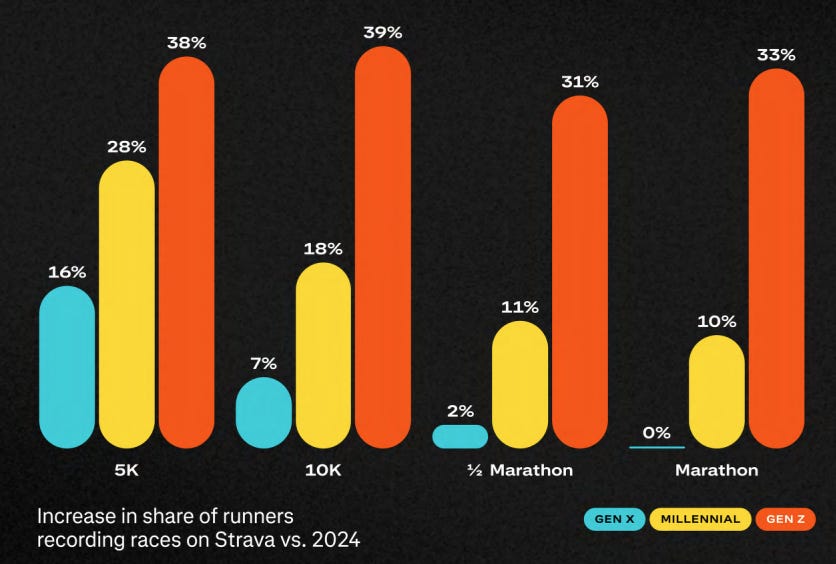
Source: Strava, read the full report here.
DNF supports this trend, but urge readers to consider the significance of a 1h30min Hyrox or 35min 5km fun-run before blasting it all over social media.
[4] A magnitude 8.2 earthquake struck off the coast of Sarangani, Mindanao in the southern Philippines yesterday, at a depth of 46km. This prompted the Pacific Tsunami Warning Centre to issue an alert for the Philippines, Indonesia, Palau, Taiwan, Papua New Guinea and Japan.
Almost 80% of tsunamis are triggered by underwater earthquakes. Unlike surface waves, which are caused by wind and storms, tsunami energy travels all the way to the ocean floor, meaning the wave moves at up to 800km/h in deep water - the speed of a commercial jet. As the wave approaches shallow water, it slows down but gains dramatic height, arriving on land not as a breaking wave but as a rapidly rising wall of water.
[5] Gen Zers are taking time saved not drinking to look for jobs. Recent graduate unemployment hit 5.7% in Q4 2025, according to Stanford Review. One of the major contributors is AI screening tools, which 90% of US employers now use. While you spend hours on Canva and Chat GPT designing the perfect layout and trying to overplay your high school second team rugby captaincy, the chances are slim that your CV ever finds human eyes.
Even more distressing is a phenomenon called “systemic rejection” where certain applicants are algorithmically blacklisted across multiple employers simultaneously as they all use the same three or four AI screening vendors. So, AI is not only eliminating entry-level jobs, but also making it harder to get one.
Beers (or a high-intensity upper body workout, we guess) on us, Gen Z.
[6] The ANC is losing its footing in South Africa. After falling below 50% for the first time in the 2024 election, the party was forced to enter the Government of National Unity (GNU) with the DA and other parties. The GNU has held up surprisingly well. Recent polling has the ANC below 30% and, for the first time in three decades of democracy, the DA is polling above the ANC among likely voters in South Africa (this, however, is according to the DA, so make of that what you will).
The GNU is going to face an interesting conundrum during the local elections between November 2026 and January 2027. Neither the DA nor the ANC can afford for it to fall apart, but both need to campaign against each other to win votes.
DNF suggests that both parties use this as a chance to return to what we believe political races should always be: promoting your own party’s ideas and initiatives instead of vilifying the opposition.
The Americans can learn a lot from this strategy as well.
[7] Pope Leo XIV is, at the risk of offending the Catholics, pretty cool. Besides wearing a pair of Nike sneakers in a trailer for his documentary and becoming a meme after a fake image of him wearing a designer white puffer jacket went viral, he recently weighed in on the AI industry boom.
The Pope dropped a 42,300-word essay titled “Magnifica Humanitas”, Latin for “Magnificent Humanity” (if you have four hours today, you can read the full essay here).
The Pope weighed in on how to safeguard the human person in the age of artificial intelligence. The leader of the Catholic Church structured his argument around a powerful Biblical contrast, the Tower of Babel (representing the dangerous path AI could take, unity without moral community, efficiency at the cost of human dignity) and the restoration of Jerusalem (shared responsibility, decentralization and using the technology to protect the vulnerable rather than amplify the powerful).
The US Government has been stepping over the Pope’s lines recently, with Pete Hegseth quoting a Bible verse which does not appear in the Bible at all, but in Quentin Tarantino’s Pulp Fiction (actually), Donald Trump posting that he will destroy a civilization on Easter Sunday, and JD Vance noting that “I think it’s very important for the Pope to be careful when he talks about matters of theology” following the Pope’s plea to stop the conflict in Iran.
Pope Leo holds degrees in math and philosophy, made his first profession in 1978, completed his theological education at the Catholic Theological Union in Chicago and, by the age of 27, moved to Rome to study Canon Law at the Pontifical University of Saint Thomas Aquinas before being ordained a priest in 1982.
Vance, on the other hand, converted to Catholicism in 2019.
[8] Bitcoin, which briefly touched $126,000 last October, prompting the usual crypto-bro chorus of “this time it’s different”, is back trading around $60,000. That’s a 50% fall from its all-time highs, which in traditional finance is called a crash, but in crypto trading is called a Tuesday. US Bitcoin ETFs, which were an attempt to legitimize the asset, have bled $3.1 billion in outflows this year.
DNF is not a fan of crypto “currencies”: it’s not a currency (unless you are based in El Salvador, where Bitcoin is legal tender, in which case Por favor, suscríbase a DNF), not a store of value (50% drawdown?) and not productive capital. It is a speculative asset designed for influencers to make money off their fanbase and 20 year old Ferrari-lessees to sell you day-trading courses. If you bought in at $3,000, congratulations.
[9] Bafana Bafana reached Mexico and played in a warm-up match against Jamaica on Saturday. The match was set to be closed-door so as to not let competitors in on Broos’s tactical masterclass.
The game ended 1-1, but the result was not the biggest issue. It seems that there was a spy who managed to capture visuals of the game that were leaked to the general public. Broos brushed off the (assumed) Mexican spy-operation, saying that his team “… know(s) enough about Mexico. I have seen enough games of Mexico. So, these things are happening, but it doesn’t bother me”.
Mexico might know a bit more about Bafana Bafana now, but tactics have not been Bafana’s edge in the past, so DNF is confident that this won’t derail their chances.
Our boys don’t need further distractions from the main goal (!), which is to get a positive result in the opening match of the tournament, which FIFA expects will be watched by 1.5 billion people around the world. Thankfully, assistant coach Mkhalele also made it, after being left behind due to the whole visa issue.
DNF can’t wait to support the team on Thursday evening at 21:00 local time.
[10] Magda Wierzycka is a Polish-South African billionaire businesswoman, the co-founder and CEO of Sygnia, the richest woman in South Africa and, it seems, a DNF reader (we are unsure why she has not subscribed yet).
Wierzycka used Sygnia’s earnings announcement to warn against the undue influence that 8 CEOs (of Anthropic, Open AI, Google, Meta, Nvidia, SpaceX, Amazon and Microsoft) have over the rapidly unfolding AI narrative.
She warned that the world is being shaped by eight unelected men making decisions on behalf of the global population. Wierzycka further noted that Sygnia will implement limited AI usage in the firm. Sygnia announced strong results, with profit after tax climbing 25.1% to R216 million for the six months ended 31 March 2026, the share climbed 0.6% as a result.
DNF is rapidly approaching 100 subscribers and 2,000 views. Share this article and, if you have not already done so, consider subscribing to receive daily updates.
Have a good Tuesday, see you tomorrow.