
Thursday, 11 June 2026
Thursday 11 June 2026
If you have the Substack app, you can now listen to our articles! Look for the big play button at the top of the article, perfect for when you are on your way to work or for when you need to pretend to be very busy at work.
[1] Yesterday, DNF wrote about a book called The Intimate Animal and hinted at the fact that global birthrates are declining. Populations in many first-world countries have seen a decline in births for a few years, as modern luxuries distracted parents enough to prevent them from having more children (a second baby or that trip to Bali?). The issue does not present in simple population statistics, because older generations are living longer, so populations continue to grow. The preferred measure is “total fertility rate” or TFR, which is a measure of the number of children per woman.
Replacement TFR, that is, the figure required to sustain a population, is 2.1 (not 2.0 because it must account for infant mortality and an uneven sex ratio at birth). About 71% of the global population lives in countries or territories with fertility rates below the replacement level, with countries such as China, the USA, Brazil and Japan all sitting well below. Africa has no such troubles though, with an average TFR of 4.0 (!). South Africa comes in at 2.2, just above replacement level. For the full data set and more information, look here.
You might think this is a good thing, what with all the “humans are destroying the Earth” narratives going around, but it’s not. Younger generations keep economic activity strong to allow for the older generation to age. A decline in population has severely negative consequences for economies.
[2] After calling the Pope cool, DNF thought it appropriate to write another section on Catholicism. John of Nepomuk, a 14th-century clergyman, heard the queen of Bohemia’s confession, only for the jealous king to ask him to divulge his wife’s secrets (the medieval equivalent of looking at your partner’s DMs). When he refused, the king had him drowned. Poor John was martyred for one of Catholicism’s most sacred tenets: the absolute seal of confession.
This raises an interesting question - should Priests tell the government about illicit activities disclosed to them by their members during confession? As it pertains to child abuse, at least six states in the US say yes. New Hampshire, North Carolina, Oklahoma, Rhode Island, Texas and West Virginia all have legislation that requires a Priest to disclose to the government on matters of child abuse. Priests, however, are bound by the rules of The Vatican as well, so they will have to make a choice between violating canon law and violating civil law. You also have the issue of religious freedom and the first amendment right of free speech.
John might have died for nothing.
[3] Super Micro Computers joins Meta and Google in looking for capital in the equity markets to build out AI infrastructure. The market does not approve. SMC shares dropped 9.3% in pre-market after the announcement. DNF cannot stress this enough - too much capital is flowing into AI infrastructure with too little clarity on what exactly the returns on these investments will be.
[4] SoftBank, the Japanese company that is building data centers in France, also announced that they need more capital, looking to raise roughly $6 billion of debt backed by their Open AI stake. The share got hammered on the news, dropping 8.3%. These are big, well-established companies with strong balance sheets openly admitting that they cannot fund what they believe to be required to compete in the AI race. This will, almost certainly, end badly.
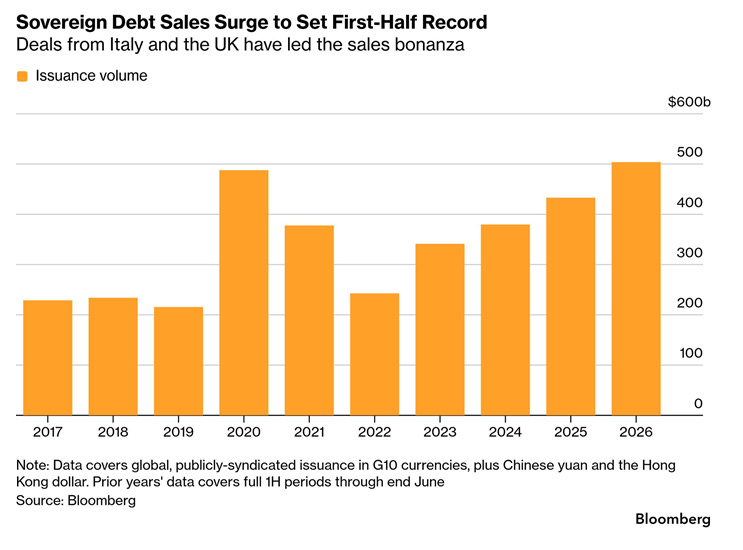
[5] Big tech companies are not the only ones scrambling for capital - governments are also issuing debt at record levels. They have collectively sold more than $504 billion of debt to institutional investors so far this year - more than in the first half of 2020, when they were trying to support their economies during Covid.
Source: Bloomberg
[7] The Supreme Court in America is debating whether the founding fathers were drunks. John Adams, Benjamin Franklin, Alexander Hamilton, John Jay, Thomas Jefferson and James Madison, among other things, wrote the Declaration of Independence, which the US celebrates on the Fourth of July every year. The reason their drinking habits are under review by the Supreme Court is due to a legal concept known as originalism, which states that the meaning of the constitution’s words should not evolve over time.
The argument under review, therefore, is that if the founding fathers were drunks, their rules should also apply to drunks (broadly speaking), otherwise the rules don’t apply at all. More specifically, to drug addicts (we’re not joking). Central to the case, for example, is whether a drug addict is allowed to own a gun, which is his or her second amendment right. The argument the originalists make is that if drunks could write the constitution, drug addicts can own a gun (?).
We are vehement supporters of the first amendment, but will reserve our opinion on the second amendment until such time that the SAPD approves our firearm license application.
[7] The FIFA World Cup is already “descending into chaos”. Omar Artan, a referee from Somalia, was refused entry into the USA after an 11-hour interview and detention. Artan was named referee of the year in 2025 by the Confederation of African Football and was set to officiate various games during the World Cup.
This follows a broader backlash against Somalis, especially in Minnesota, which is the largest Somalian diaspora in the States. ICE, the government agency whose job it is to enforce immigration and customs rules, has been struck by immense public pressure following the murder of two Americans, Alex Pretti and Renée Good, at the hands of ICE agents. This is a controversial and nuanced topic, but is further evidence of the global politicization of immigration DNF mentioned in previous reports.
[8] America’s Commodity Futures Trading Commission (CFTC, the federal body that regulates derivatives) is proposing a new regulatory framework for prediction markets (platforms where you can bet money on the outcome of real-world events, from elections to the Oscars to war. Think gambling, then stop thinking). Betting markets have become infested with insider trading (for example, you could bet on when Drake will release that awful album. If you were on his production team, you might have had an edge, no?) and regulation is certainly required.
The rules will not outright ban any specific category of bet. Instead, the CFTC will review contracts case by case and block those it deems against the public interest or susceptible to manipulation (what a great idea!). What’s almost certainly out: bets on player injuries, first-pitch outcomes in baseball, and virtually all war, terrorism and assassination contracts (which were fair game until now).
The last category is particularly appropriate. A US soldier was charged in April for allegedly trading prediction market contracts ahead of the operation that led to Venezuelan president Nicolás Maduro’s arrest (AR-15, check. Night vision goggles, check. Life savings on a Polymarket bet, check. Bravo-6, rolling out).
What makes this interesting is who is being regulated and who is doing the regulating. The CFTC’s Trump-appointed chair, Michael Selig, has been aggressively permissive toward prediction markets (anyone surprised?) suing states like Illinois that tried to shut the platforms down. The platforms in question include Kalshi and Polymarket.
One of Trump’s sons is an adviser to both. The Trump family has a direct financial interest in the industry whose regulator the Trump administration controls. Not surprising, at all, but concerning as the gambling epidemic sweeping the US (and South Africa, with men in their 20s being the prime candidates to get caught up) continues.
[9] The 2026 FIFA World Cup opens on Thursday at the Estadio Azteca or, as FIFA has decided to call it for the duration of the tournament, “Mexico City Stadium.” Sixty years of history, two World Cup finals, the Goal of the Century, the Hand of God, and a Man of God (Pope John Paul II addressed 100,000 worshippers in the stadium in 1999) were apparently insufficient to justify keeping the name.
FIFA, an organization not known for its restraint when it comes to commercial decisions (also known for blatant corruption), has apparently decided that “Azteca” doesn’t test well in sponsor focus groups. DNF will be using the real name.
The Azteca is the most storied ground in football history. It hosted the 1970 final, a 4-1 Brazilian demolition of Italy that featured nine different players touching the ball before Carlos Alberto scored. In the quarter final of the 1986 World Cup, it witnessed Diego Maradona deliver, in the same game, both the most dishonest goal and the most brilliant goal ever scored at a World Cup. The Hand of God (a goal which saw Maradona use his hand to punch the ball into the back of the net) followed four minutes later by a 60-metre solo effort past half the England squad (Maradona has struggled with a cocaine addiction since the 1980s, which might explain it - why is this a recurring theme?). Argentina went on to win the 1986 World Cup, also in the Azteca.
But this all pales in comparison to what Bafana Bafana is going to do tonight when they run onto the famous pitch to face Mexico in front of their home crowd.
[10] On Wednesday, Taiwan’s army drove truck-mounted Himars (US-made High Mobility Artillery Rocket Systems) to the western coast of the island and, for the first time, launched 32 rockets directly into the Taiwan Strait. The western coast faces China. It is also considered the most likely landing point for any Chinese amphibious invasion. The choice of location was not subtle.
The exercise was a dual message directed at Beijing and Washington simultaneously, which says something about Taiwan’s current predicament.
To China: any attempt to cross the strait with landing craft will be met with missile fire before a single soldier touches the beach.
To the Trump administration: Taiwan is serious about its own defense, and the $14 billion US arms package that Trump has put on hold which he described in May as “a very good negotiating chip” in his dealings with Xi Jinping - should be released. Taiwan is doing its part. Washington is the variable.
The arms-sale-as-leverage framing is genuinely uncomfortable. Xi has told Trump he opposes US arms sales to Taiwan. Trump has obliged by sitting on the package. Taiwan, rather than wait, fired missiles into the strait.
Russia vs Ukraine, USA vs Iran, China vs Taiwan, Bafana Bafana vs Mexico, Knicks vs Spurs, Strait of Hormuz vs Strait of Taiwan, Everyone vs The US Government, DNF vs AI - what a stunning time to run a newsletter.
The world is burning friends, but it always has! See you tomorrow.