
Friday, 19 June 2026
Friday 19 June 2026
[1] Points (1) to (3) will be looking at comparative returns year-to-date. As we approach the halfway mark of 2026 and the end of Q2, let’s check in on where money was made and where money was lost.
Index Returns Year-to-Date (YTD)
Source: Bloomberg
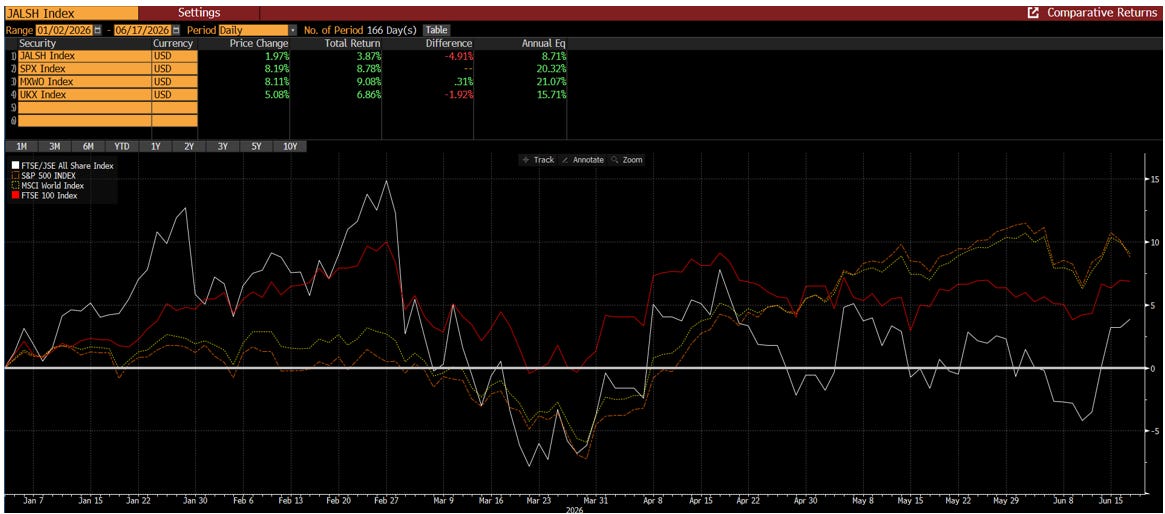
We start by looking at the JSE (South Africa), S&P500 (United States), MSCI World (global developed markets) and FTSE100 (United Kingdom, also known as the Footsie, not to be confused with flirty under-the-table behavior). All returns are in USD terms (which means that we are comparing apples with apples. This is best for comparison, but if you invest in ZAR, you should know that the JSE is actually down roughly 0.6% YTD. It is only positive in USD terms due to the Rand strengthening against the Dollar).
Our leader is the MSCI World index, instructive on the power of diversification, but past returns are not indicative of future performance. The MSCI World is up 9.08% YTD.
In second place is the S&P500, up 8.78% YTD on the back of strong AI related gains.
Third is the FTSE100, up 6.86% YTD and in last place on our leaderboard is the JSE, which is up 3.87% in USD terms.
[2] Let’s look at commodities.
Commodity Returns
Source: Bloomberg
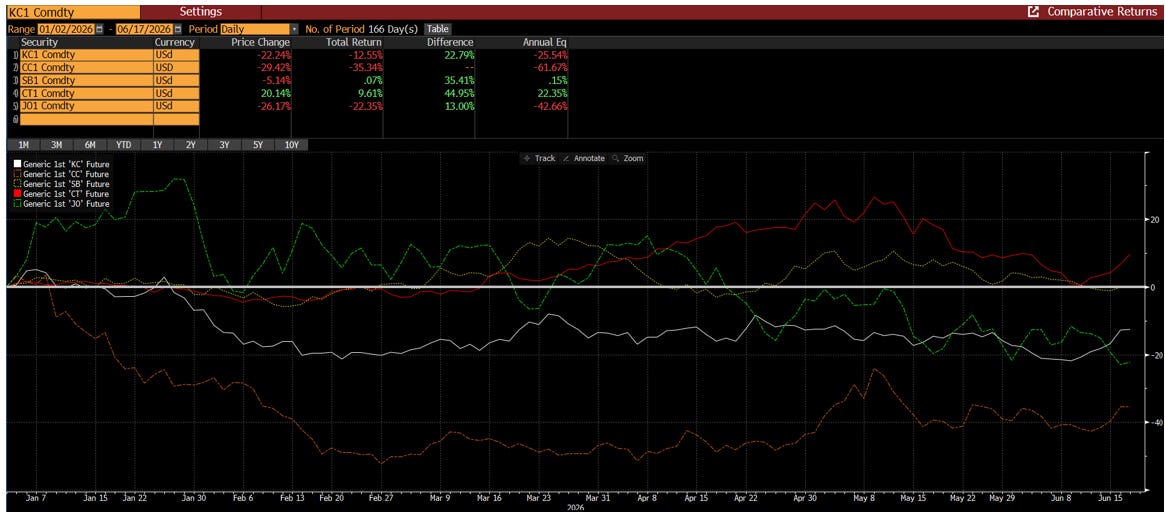
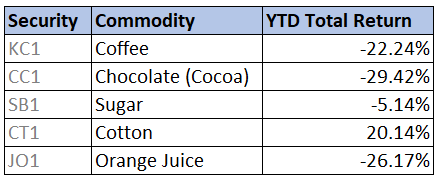
We chose our commodity watch list based on what we thought readers would find interesting. The Bloomberg security codes are confusing, so here is the table above in plain language:
Source: Internally Generated
Breakfast and sugary treats should be cheaper, while clothes will probably tick up on cotton strength. This is a very, very basic explanation and the supply chain of Plato coffee, Woolies clothes and Lindt chocolate is significantly more complicated than the above chart (also, cheaper coffee beans means bigger margins for Plato, not cheaper flat whites for consumers), but it is interesting to think about trading desks in financial services firms trading coffee beans and orange juice pulp.
In fact, many of these firms gain an edge by accurately forecasting weather in the regions where the crops are cultivated. They even send analysts to production plants to physically inspect stock. The world of finance is further reaching than simply buying and selling stocks.
Coffee prices are falling due to a shift toward global supply surplus, driven by a projected 17.1% jump in Brazil's harvest and expanding crop outputs in Vietnam, Colombia, and Ethiopia (coffee beans love the equator). Brazil accounts for roughly a third of the global coffee supply.
[3] We couldn’t miss an opportunity to make fun of the cryptocurrency lunatics.
Crypto, Gold and Cash
Source: Bloomberg
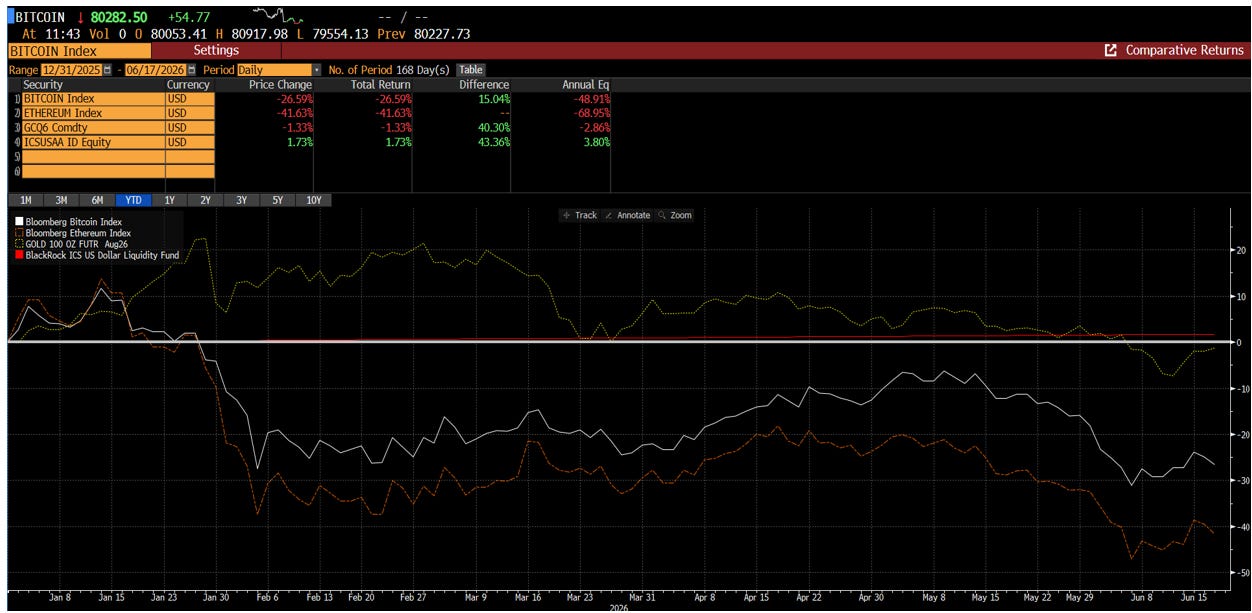
Bitcoin and Ethereum are down 26.59% and 41.63% respectively. We added gold (which is down 1.33%) as many early crypto adopters argued that Bitcoin’s value proposition is similar to gold because of the finite supply (they missed the part where gold is a physical thing you can touch, the basis for the entire modern currency system and looks sick when melted down and worn as a chain).
Finally, to add insult to injury, we added the BlackRock USD Liquidity fund, which is essentially cash return. If you had kept your money in cash, you would have outperformed gold, Bitcoin and Ethereum (broadly speaking).
Also, because we fear crypto-junkies won’t understand this basic concept, if you have $100 and it loses 40%, you now have $60. To get back to $100, it must increase not 40% (which will get you to $84), but c67%! Down is quick, up is slow, unfortunately.
[4] Kevin Warsh is in a difficult position. His predecessor, Jerome Powell, was bullied out of the Federal Reserve by Trump who got upset about paying high interest rates to fund his wars. Enter Mr. Warsh, who now faces the same economy and is quickly realizing that the only way, for interest rates, is up.
Warsh used his debut press conference as Chairman of the Federal Reserve on Wednesday to make clear that the central bank won’t tolerate high inflation.
The hawkish message (when talking about stocks, bull is up and bear is down, when talking about interest rates, hawk is up and dove is down, don’t ask why) was driven home by the projections of individual Fed members, half of whom expect to raise rates by the end of the year.
Before the latest meeting, Wall Street had largely assumed the Fed was done cutting rates ever since the Iran war’s oil shock sent consumer prices surging by the most in three years (well done Mr. Make-America-Affordable-Again).
The market was, legitimately, waiting to see if Warsh would give in to Trump (sad). DNF is relieved that sound economic principles still rule at least a corner of the market.
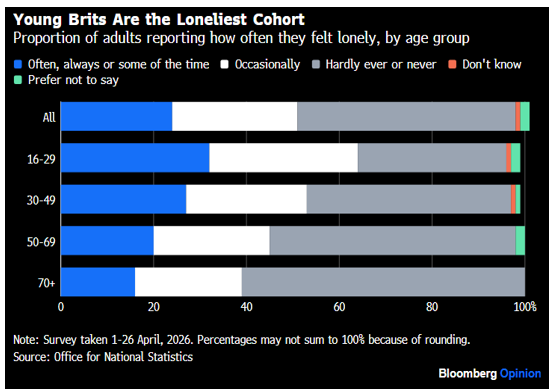
[5] Brits are lonely, specifically the younger generation.
Source: Bloomberg
The transition into adulthood is becoming more difficult for young Brits, with nearly a million young people in the UK classified as NEETs - a term referring to people aged 16 to 24 who are not in education, employment or training. To put that into perspective, one in eight are detached from both learning and work.
Laziness is not the only problem, with many youngsters struggling to find jobs or to gain access to training and education, a consequence of a faltering government.
Even more worrying is that 32% of 16 to 29 year old’s report feeling lonely often, always, or some of the time. Loneliness has been associated with increased risk of severe illness, mental health problems and early death. One study compared sustained periods of loneliness to smoking 15 cigarettes a day.
At the risk of sounding old-school, DNF will blame social media and smartphones. Bar with friends? Fortnite. Date with a girl? Snapchat. Five-a-side soccer with the boys? Discord. Humans have never been more connected, yet we are further away from one another than ever before.
[6] Portugal was held to a 1-1 draw against Congo on Wednesday. Congo, which was playing at the World Cup for the first time in 52 years, became the second African nation to make a strong start in the tournament against European competition, following Cape Verde’s 0-0 draw with Spain on Monday.
(By the way, Vozinha, the Cape Verde goalkeeper who was the hero in the draw against Spain, went from 50k to 13.3 million followers on Instagram after the game. Apparently, many of his new fans belong in the attractive young woman category… save a shot on the field and shoot your shot on-the-line Josimar!)
Congo played in front of a crowd of mostly Portuguese supporters as travel bans prevented many Congolese from making it to the US because of restrictions tied to Ebola. João Neves, standing at all of 5 foot 7, headed Portugal to an early lead in the sixth minute, before Yoane Wissa equalized for Congo with a header in stoppage time at the end of the first half. This was the first World Cup goal for Congo in its history.
Between Cape Verde and Congo, DNF believes that the African continent’s TFR (total fertility rate, a measure of children-per-woman) we reported on last week remains safe and sound.
[7] Trump has signed a memorandum of understanding with Iran. The US administration has been rather secretive about its contents, which indicates that they are very confident in the deal…
Bits and pieces of the memorandum have been reported, and it seems almost certain that:
a) Iran will have greater power over the Strait of Hormuz than before the war.
b) Iran will have access to roughly $300 billion to rebuild its economy.
c) The US will respect and acknowledge the country’s sovereignty and leave its internal affairs alone.
d) The US will work to discontinue any sanctions on the Iranian regime.
It’s Friday, so we will not go into detail. But this is clearly an incredible defeat and embarrassment for Trump and the United States. More on that on Monday.
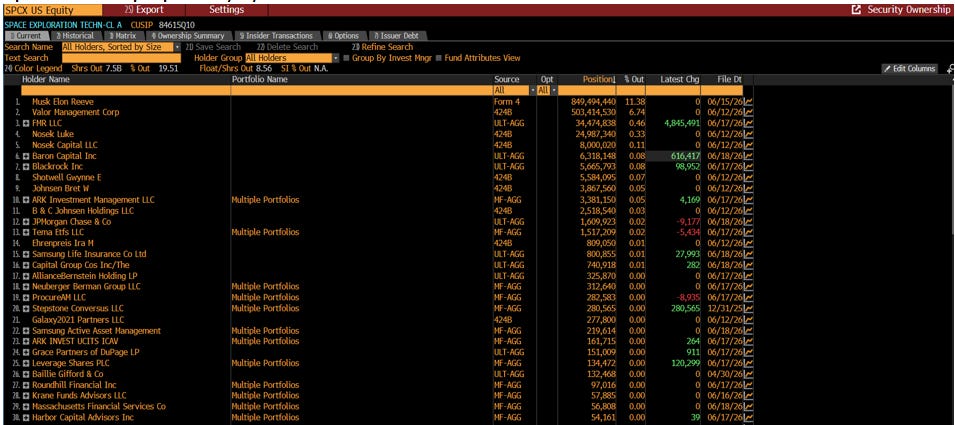
[8] Now that SpaceX is up and trading for almost a full week, let’s look at who owns the shares:
SpaceX Class A Ownership (18 June 2026)
Source: Bloomberg
Musk is sitting pretty at 11.38% of the outstanding class A shares. But the 11.38% figure is not really important. The important part is the class B shares, which hold the voting rights:
SpaceX Class B Ownership (18 June 2026)

Source: Bloomberg
As you can see, Musk owns 68.77% of the Class B shares, giving him full and total control over the company. So, not only are shareholders buying into a ridiculous valuation, they will also not enjoy any of the voting privileges and rights usually assigned to holders of public equity. To the moon (or Mars, we guess) Elon!
[9] GOAL! Bafana Bafana played their second match against Czechia. After going down 1-0 in the sixth minute, Bafana won a penalty in the 81st minute after a handball was called. Mokoena stepped up and calmly slotted a well struck penalty in the bottom left corner. The match finished 1-1, a big result for Bafana. We are proud of our boys, but suggest that Broos has a chat with the team about discipline.
[10] The U.S. Open is underway at Shinnecock Hills. The course derives its name from the Shinnecock Indian Nation, who lived on these lands long before European settlement. Tribe members built the early holes in 1891, and local teenagers Oscar Bunn and John Shippen both became part of golf history at the 1896 U.S. Open.
In subsequent generations, however, disputes arose over land rights. The tribe has challenged the 1859 sale of its territory, alleging it was taken illegally. While federal courts dismissed the lawsuit, tensions have persisted regarding ancestral burial grounds and use of tribal lands.
The 7,440 yard par 70 course is a true test. Brooks Koepka won the previous iteration of the tournament at Shinnecock in 2018 with a final score of one over par. Bookies have Rory McIlroy as the favorite to win, followed by Scottie Scheffler, Ludvig Aberg and Jon Rahm.
[11] DNF finishes the week with 130+ subscribers and 3,000+ views across all articles. We remind readers to share our work (it helps a lot!) and catch up on previous articles over the weekend. Thank you for the continued support, we are having a lot of fun.
Have a great weekend everyone!